Log Analyser
Modular Python CLI tool for parsing and analyzing large-scale log files with high-performance regex and structured reporting.
A robust Command Line Interface (CLI) tool designed to process and analyze server log files. It demonstrates high-performance text processing using Python's standard library, providing a modular architecture that separates parsing logic from data analysis and reporting.
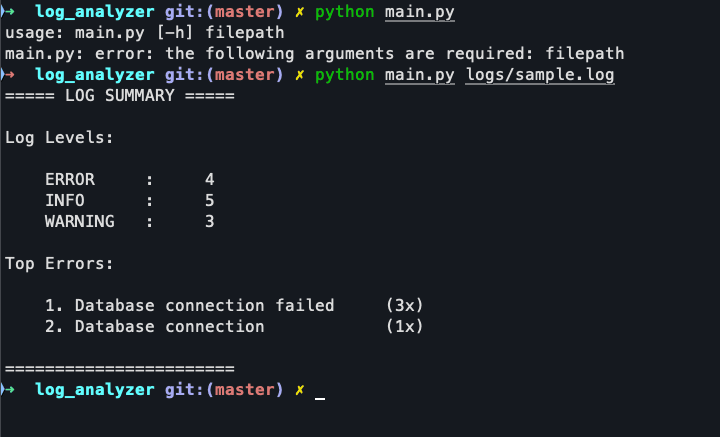
Project Overview
Log Analyser is a specialized CLI utility built to solve a common developer problem: extracting meaningful insights from messy, high-volume log files. Instead of manually searching through thousands of lines, this tool provides a structured summary of log levels and the most frequent error messages.
Technical Implementation
The project is built with a focus on clean code and performance, using a modular approach that follows the Single Responsibility Principle.
High-Performance Parsing
The heart of the tool is a robust parser that uses pre-compiled regular expressions. By using named capture groups (e.g., (?P<level>...)), the parser efficiently extracts:
- Timestamps
- Severity Levels (INFO, WARNING, ERROR, CRITICAL)
- Message Content
The use of generators (line-by-line processing) ensures that the tool can handle files much larger than the available RAM without performance degradation.
Data Analysis
Statistical analysis uses Python’s collections.Counter, which gives near-instantaneous counting of log occurrences and efficient identification of the n most frequent error messages using the .most_common() method.
Modular Architecture
The codebase is strictly organized into four key modules:
parser.py: Handles text extraction and regex matching.analyzer.py: Performs statistical computations on the parsed data.reporter.py: Formats and prints the final report using advanced f-string alignment.main.py: Acts as the orchestrator and handles CLI arguments viaargparse.
The Challenge
- Efficiently processing potentially massive log files without loading the entire content into memory
- Creating a flexible regex pattern that can handle variations in log formatting (timestamps, multi-word messages)
- Implementing a modular design using only the Python standard library to ensure zero external dependencies
The Approach
- Implemented line-by-line reading with pre-compiled regular expressions using named capture groups for high-speed parsing
- Utilized Python's `collections.Counter` for rapid frequency analysis of log levels and error messages
- Designed a decoupled architecture (Parser -> Analyzer -> Reporter) to allow for independent testing and extensibility
Results
- A fast and reliable CLI tool that generates structured reports in seconds
- Demonstrated proficiency in core Python engineering and software architecture principles
- Provides a reusable utility for DevOps and backend debugging tasks
Impact
It opens huge log files, bigger than the machine's memory, and tells you how many errors there are and which ones repeat most. Nothing to install beyond Python. To read a different log format you change one line.
Project Details
Objective
Create a lightweight, dependency-free utility to help developers quickly identify error patterns and log statistics from large text files.
Theme
Technical and minimalist CLI tool aesthetic.
Date
March 19, 2026